Voice Agent Economics in 2026

Ian Eaves
2026-06-0111 min read
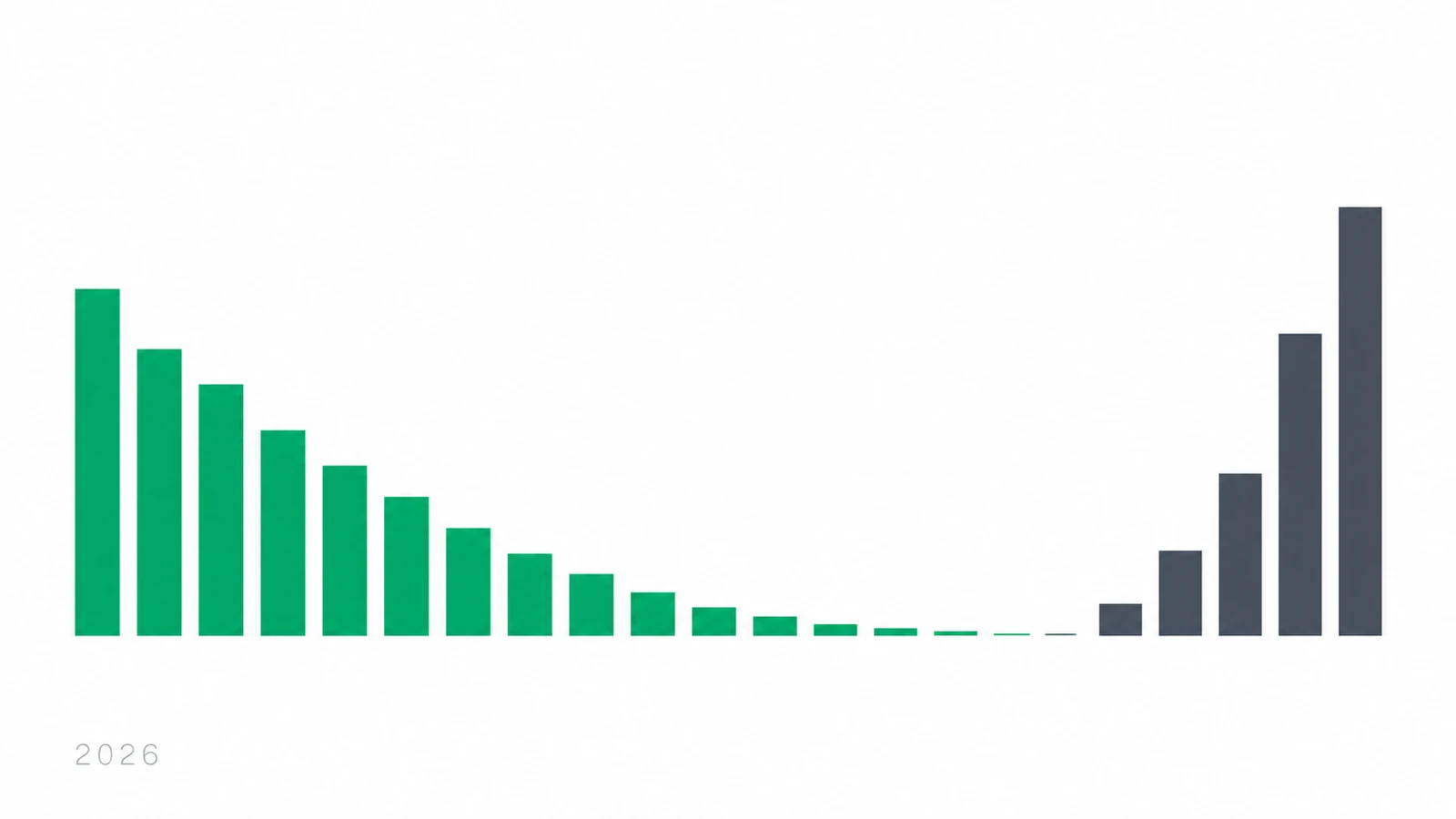
Native speech-to-speech now runs 3–12× cheaper than cascaded STT → LLM → TTS stacks at comparable latency and task success. Here's when to pick native, when cascades still win, and what changed.
For most enterprises, cascaded architectures remain the workhorse strategy for building voice agents.
A user speaks. The system transcribes the audio with a speech-to-text model. The transcript is passed to an LLM, which reasons, calls tools, retrieves data, or updates state. The response is then sent to a text-to-speech model, which generates audio back to the user.
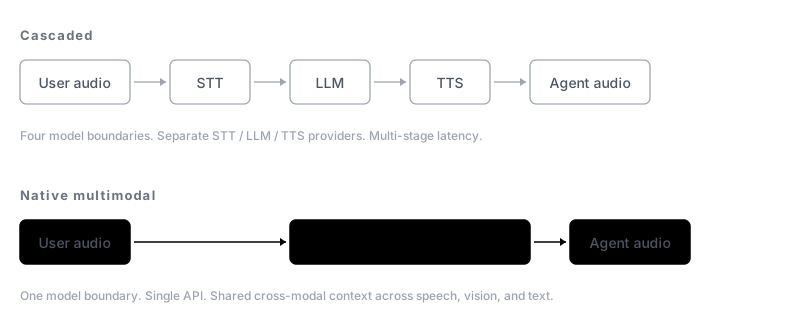
That architecture, though complex, remains valuable. It is modular, observable, and easy to control. Enterprise buyers often prefer cascades because each stage can be upgraded, instrumented, and governed independently. A team can swap the STT model, change the reasoning model, replace the TTS provider, add compliance checks between stages, or route a request into a specialist control loop.
Direct speech-to-speech architectures have been available for some time, but they have historically struggled with the reasoning, tool use, and control requirements that traditional LLMs support in cascaded systems. Native speech-to-speech agents now appear to be crossing that practical threshold. For a growing set of applications, especially low-latency and multimodal ones, a single speech/vision/text model can now be the better choice.
The right architecture depends on the balance of price, latency, visual grounding, tool reliability, control, and engineering simplicity.
For many hobbyist, consumer, startup, and multimodal applications, native speech-to-speech is now the strongest option. For enterprise workflows that maximize accuracy, auditability, tool calling, and deterministic control, cascades will continue to coexist with native agents.
What changed
Open models like Qwen3-Omni now make native speech-to-speech practical for workloads that also require vision, text, or video understanding.
Qwen3-Omni uses a Thinker–Talker Mixture-of-Experts architecture. The Thinker handles multimodal understanding and text generation. The Talker generates streaming speech tokens. The architecture unifies perception and generation across text, images, audio, and video, and supports speech output in addition to text output. Qwen3-Omni supports text interaction in 119 languages, speech understanding in 19 languages, and speech generation in 10 languages. It also uses multi-codebook speech codec prediction and a lightweight causal ConvNet for streaming speech generation, with a theoretical cold-start first-packet latency of 234 ms. arXiv
Sprag hosts Qwen3-Omni-30B-A3B-Instruct for text, image, audio, and video workflows, with text and audio outputs available through OpenAI-compatible chat and responses-style requests. Sprag
Now, a native multimodal model can listen to a user, interpret an image or video frame, reason over text context, and respond directly in speech. The builder no longer has to manage state across separate STT, LLM, vision, and TTS systems on every turn.
The strongest practical benefits are:
- lower price
- lower latency
- native visual grounding
- reduced engineering surface area
- simpler architecture
Traditional cascades still have advantages. They can use the strongest specialized tool-calling models and the most polished standalone TTS systems. Their control points are better understood and their failure modes are easier to isolate. Still, the architectural frontier has moved far enough that native speech-to-speech deserves direct evaluation.
Why vLLM-Omni-style serving matters
A native multimodal model still needs the right serving stack. A simple implementation can create hidden sequential bottlenecks: process the user's speech, finish reasoning, prepare speech tokens, synthesize waveform audio, then return the response. That shape recreates some of the pipeline latency inside the model stack.
vLLM-Omni addresses this serving problem for any-to-any multimodal models. It introduces a stage abstraction that decomposes complex multimodal architectures into interconnected stages, with independent execution backends, per-stage batching, flexible GPU allocation, and connectors for routing data across stages. In the vLLM-Omni evaluation, this serving approach reduces job completion time by up to 91.4% compared with baseline methods. arXiv
For Qwen3-Omni, the serving path maps naturally onto three stages:
- Thinker: multimodal understanding and text/semantic generation
- Talker: semantic representation to speech codec codes
- Code2Wav: speech codec codes to audio waveform
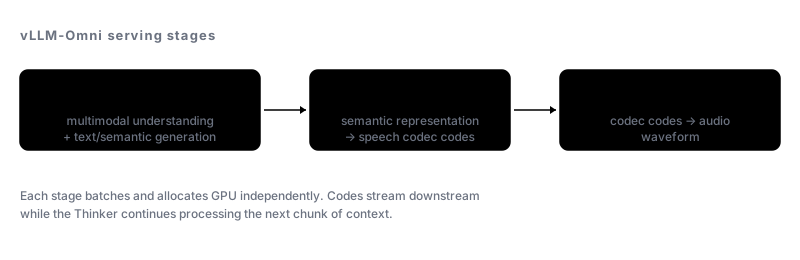
The serving stack can move work through the speech-generation path while upstream stages continue processing. Each stage can be batched and allocated independently rather than forcing the entire request through one monolithic execution path.
vLLM-Omni-style serving helps turn native speech-to-speech from a model capability into a production serving architecture. Sprag runs Qwen3-Omni on top of vLLM-Omni, which makes the low-latency and cost profile practically relevant rather than merely theoretical.
Benchmarking the tradeoff
Sprag benchmarks voice systems across STT, TTS, and agentic workflows. Agentic benchmarks compare native speech-to-speech agents against staged transcribe → reason → speak systems using provider APIs. Sprag Benchmarks
In our measurements, Sprag-hosted Qwen3-Omni-30B is highly competitive on time to first audio and wins overall on end-to-end latency across the benchmarked agentic task.
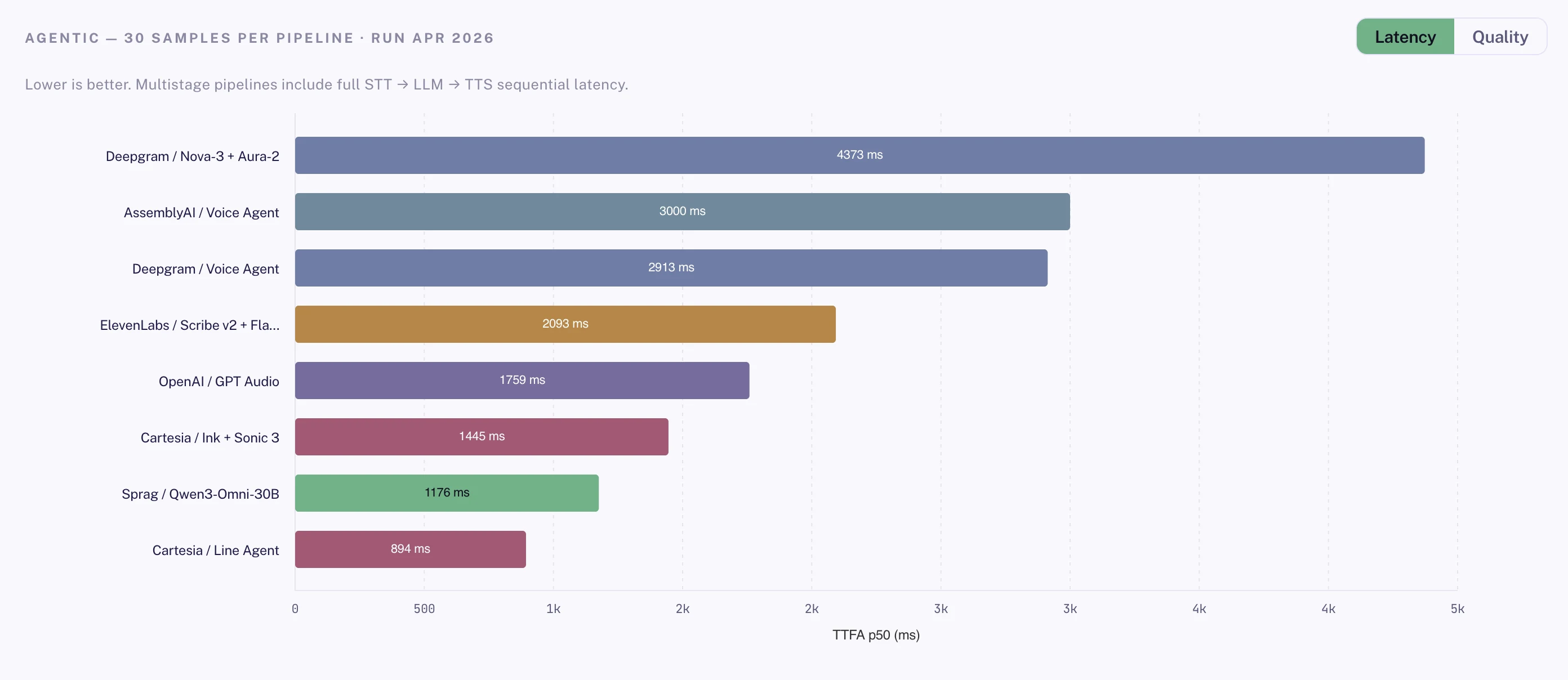
The TTFA distribution shows Sprag / Qwen3-Omni-30B with a max TTFA of 1.176 seconds. Comparable systems in the chart include Cartesia Ink + Sonic 3 at 1.445 seconds, OpenAI GPT Audio at 1.759 seconds, ElevenLabs Scribe v2 + TTS at 2.093 seconds, Deepgram Voice Agent at 2.913 seconds, AssemblyAI Voice Agent at 3.000 seconds, and Deepgram Nova-3 + Aura-2 at 4.373 seconds.
Speed alone is not the full story. The scatter below plots end-to-end latency against task success on the agentic benchmark. Top-left is the quadrant that matters: fast AND actually completes the turn. Several systems start talking quickly but fail the underlying task; Qwen3-Omni-30B is the only system in the set that pairs sub-second responsiveness with high task success.
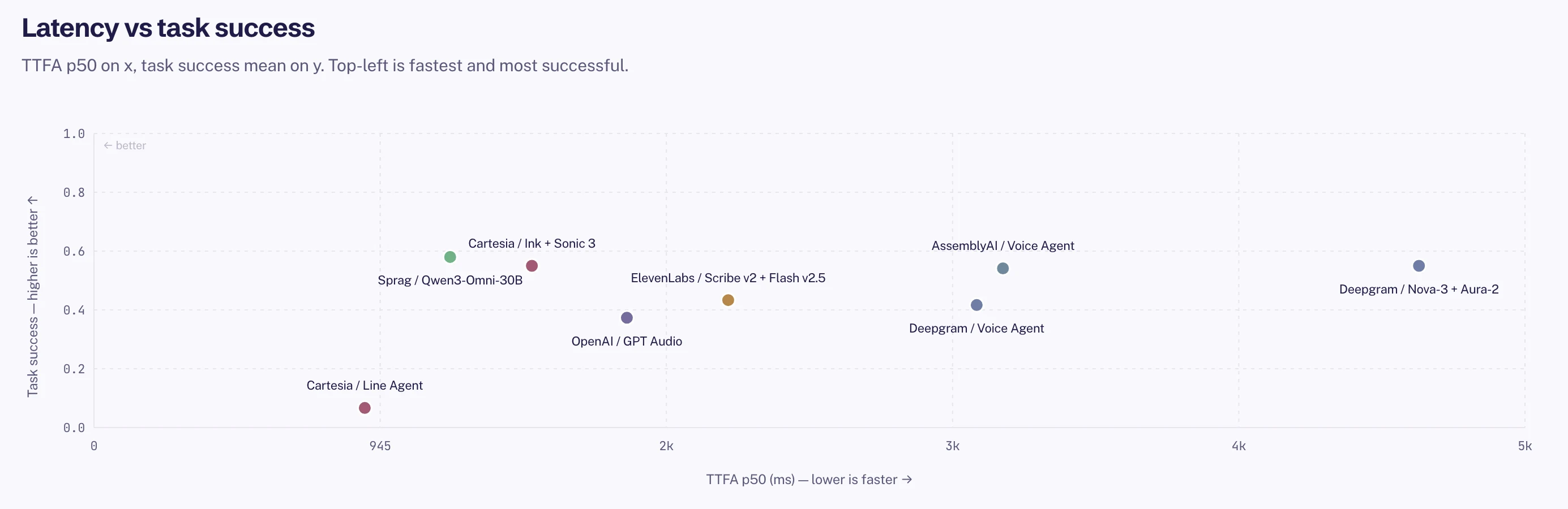
The latency result matters because voice interfaces are highly sensitive to delay. A sub-second or near-sub-second response changes the feel of the product. The user experiences the agent less like a web request and more like an interactive system.
Pricing changes the architecture discussion
Cost is one of the clearest reasons native speech-to-speech is becoming interesting for buyers.
A cascaded voice agent pays for multiple components:
- speech-to-text
- LLM reasoning and tool use
- text-to-speech
- orchestration and monitoring
A native speech-to-speech model can collapse much of that stack into a single multimodal serving path. Actual bills still depend on speech ratio, silence handling, context length, tool schemas, retries, provider-specific billing rules, image/video use, and generated response length.
Using Sprag's current Qwen3-Omni rate card:
- Audio input: $0.00255 / minute
- Audio output: $0.0102 / minute
For a normalized 50/50 call-minute — thirty seconds of user speech and thirty seconds of generated agent speech — the audio cost is:
0.5 × $0.00255 + 0.5 × $0.0102 = $0.006375
So the Sprag/Qwen3-Omni audio cost is approximately $0.0064 per 50/50 call-minute.
For cascades, the full cost of an agent round trip includes STT, LLM, and TTS. The table below uses a conservative GPT-4o-class reasoning estimate: 1,000 input tokens + 250 output tokens per call-minute ≈ $0.005 per call-minute. GPT-4o is priced at $2.50 per 1M input tokens and $10.00 per 1M output tokens. OpenAI Developers
That LLM estimate can increase with long system prompts, tool schemas, RAG context, conversation history, retries, and verbose tool outputs.
Pricing as of May 2026:
| Stack | Cost basis | Approx. 50/50 call-minute | Multiple vs. Sprag |
|---|---|---|---|
| Sprag / Qwen3-Omni-30B | Native audio input + audio output | $0.0064 | 1.0× |
| Cartesia Ink + Sonic 3 + GPT-4o-class LLM | STT + TTS + LLM | $0.0195 | 3.1× |
| Deepgram Nova-3 + Aura-2 + GPT-4o-class LLM | STT + TTS + LLM | $0.0224 | 3.5× |
| ElevenLabs Scribe v2 Realtime + Flash/Turbo + GPT-4o-class LLM | STT + TTS + LLM | $0.0308 | 4.8× |
| OpenAI GPT Audio / GPT-Realtime-2 | Native realtime audio model | ~$0.0480 | ~7.5× |
| Deepgram Voice Agent API | Bundled voice-agent API | $0.0750 | 11.8× |
| AssemblyAI Voice Agent API | Bundled voice-agent API | $0.0750 | 11.8× |
The table uses provider-published pricing and a normalized call-minute. Cartesia lists Scale annual pricing at $239/month with 8M model credits, Sonic at 1 credit per character, and Ink at 1 credit per second of audio, with Ink described as $0.13/hr on Scale. Cartesia Deepgram lists Nova-3 streaming rates, Aura-2 at $0.030 per 1K characters, and Voice Agent API Standard at $0.075/minute based on WebSocket connection time. Deepgram ElevenLabs lists Scribe v2 Realtime at $0.39/hour and Flash/Turbo TTS at $0.05 per 1K characters. ElevenLabs AssemblyAI lists its Voice Agent API at $4.50/hr. AssemblyAI OpenAI lists GPT-Realtime-2 audio at $32/M input audio tokens and $64/M output audio tokens, and its realtime cost guide documents user audio at 1 token per 100 ms and assistant audio at 1 token per 50 ms. OpenAI
Pricing comparisons favor native speech-to-speech even before accounting for engineering surface area. A pipeline can still be cost-effective with inexpensive STT and TTS components, especially at low volume or with a cheaper LLM. At scale, the combined cost of STT, LLM, TTS, orchestration, logging, retries, and integration work becomes part of the architectural decision.
Tool calling is now viable in native speech-to-speech
Historical skepticism toward direct speech-to-speech agents was justified. Early systems were fast and natural but difficult to control. Enterprise applications often need structured tool calls, strict validation, audit logs, policy checks, database access, and deterministic routing. Native speech-to-speech systems are improving on those dimensions.
Qwen3-Omni supports native function-calling workflows, and its architecture leaves room for control. Because the Thinker and Talker are decoupled, external modules such as RAG, function calling, and safety filters can intervene on the Thinker's textual output before speech synthesis. arXiv
That makes native speech-to-speech with tools a real option. The practical enterprise question becomes:
For many use cases, good tool calling is enough. A consumer assistant, visual troubleshooting agent, robotics-adjacent interface, or lightweight support workflow may benefit more from native multimodality and low latency than from maximum orchestration control.
For workflows involving inventory databases, order-management systems, EHRs, regulated actions, or complicated escalation paths, cascades remain attractive. A staged architecture gives teams explicit checkpoints: transcript, LLM request, tool call, tool result, policy decision, final response, speech output.
Why cascades will continue to matter
For enterprise buyers, cascades retain several advantages.
First, they are flexible. A team can upgrade the reasoning model when a better LLM becomes available. They can replace the voice model without changing the tool loop. They can tune STT separately for domain vocabulary. They can add validation, redaction, human review, or compliance checks between components.
Second, cascades are easier to instrument. Each stage produces artifacts that can be logged, tested, replayed, and evaluated separately. Teams can measure transcription accuracy, tool-call validity, policy compliance, TTS latency, and end-to-end user experience with clear attribution.
Third, cascades support complicated control loops. Consider an order-management assistant that has to identify a customer, inspect inventory, check refund eligibility, update a record, detect regulated cases, and escalate to a specialist agent. In a cascade, routing decisions can happen between components. The system can redirect the request before generating the final spoken response.
Native speech-to-speech systems can support many of these patterns, especially when they expose transcripts, text outputs, and tool-call surfaces. The tooling is improving quickly. Enterprise teams still need to evaluate the maturity of the runtime control layer, especially for mid-turn redirection, policy gates, audit trails, and multi-agent handoff.
Native multimodality matters beyond voice
Voice plus vision is one of the strongest reasons to care about native speech-to-speech.
A user might speak while showing the agent an object, a document, a product, a damaged part, or a live environment. A cascade can support this by separately capturing an image, summarizing it, inserting that summary into a prompt, and then generating speech. That approach works, but every modality handoff adds orchestration complexity.
Native multimodal models offer a cleaner abstraction. The same model can hear the instruction, see the relevant visual context, use text or tool context, and generate a spoken response with major practical advantages:
- shared context across speech, vision, video, and text
- fewer modality handoffs
- less application glue
- faster prototyping
- cleaner multimodal state management
Robotics and embodied assistants are a natural forward-looking example. A robot or field assistant needs to jointly interpret what it sees and what a person says. Commands like "pick up the red connector next to the loose cable" or "is this part installed correctly?" require visual grounding and spoken interaction at the same time.
A staged architecture can be made to support that interaction. Native speech + vision is a more direct model of the task.
How buyers should choose
Native speech-to-speech should be favored when:
- low latency matters
- cost matters
- voice + vision matter
- architecture simplicity matters
- the product is highly interactive
- good tool calling is sufficient
- the team wants to reduce orchestration work
Cascades should be favored when:
- best-in-class tool calling is mandatory
- strict auditability is required
- deterministic control matters
- compliance checkpoints are central
- each model component needs to be swapped independently
- the workflow depends on complex routing across tools, policies, databases, and specialist agents
Hobbyists and consumer-app builders will often get the most immediate value from native speech-to-speech. Low latency, simpler architecture, lower price, and native voice + vision support make it easier to build compelling products quickly.
Startup builders care about time to market and engineering surface area. A cascade requires teams to select, integrate, prompt, monitor, and debug multiple providers. A native multimodal agent collapses much of that application layer.
Enterprise buyers will need to be more selective. Accuracy, tool calling, auditability, and control tend to dominate. Native speech-to-speech becomes compelling when the workflow can tolerate good tool calling in exchange for lower latency, lower cost, and simpler multimodal architecture.
The takeaway
Speech-to-speech agents are finally viable.
Cascades will continue to be the right architecture for many enterprise systems. Their strengths are real: control, modularity, auditability, and access to the strongest specialized components.
Native multimodal speech agents now deserve a serious place in the architecture discussion. Models like Qwen3-Omni, served through vLLM-Omni-style infrastructure, can deliver low-latency speech interaction, native visual grounding, tool-capable workflows, and a materially cheaper cost profile.
If you're building voice agents, the next step is to benchmark native speech-to-speech and cascaded agents against your actual workloads. Sprag hosts Qwen3-Omni for text, image, audio, and video workflows, with text and audio outputs through OpenAI-compatible chat and responses-style endpoints. If you want to test native agents against your workload, we would be happy to help.